How Much Does It Really Cost to Renovate an Akiya?
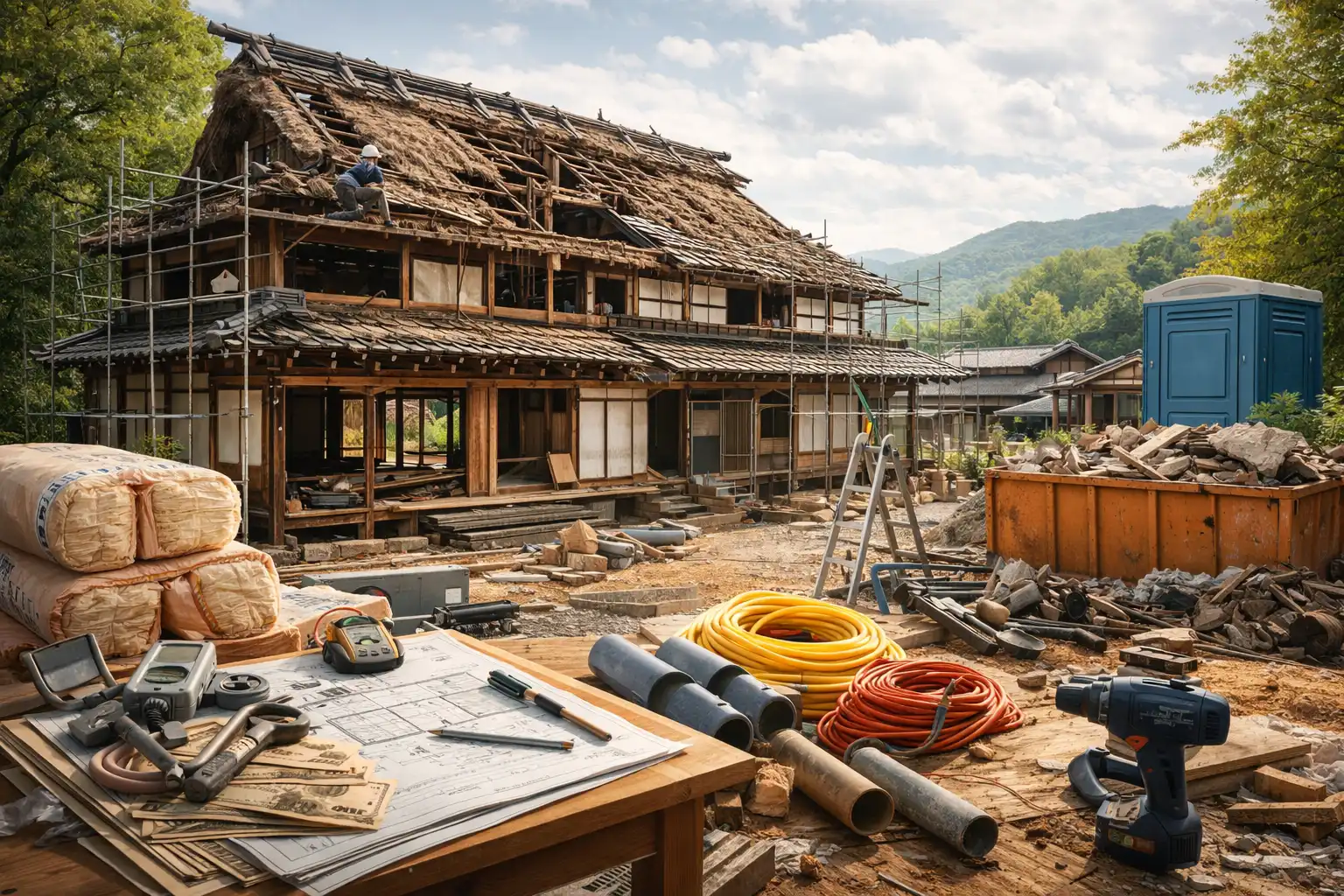
The listing price of an akiya is almost never the expensive part. A house listed for ¥1 million can easily require ¥5–10 million in renovation before it's livable. This is the number one surprise for foreign buyers — and the reason many "cheap" akiya aren't cheap at all. Here's a realistic breakdown of what renovation actually costs in Japan, category by category.
Three tiers of renovation
Not every akiya needs a full rebuild. Where your project falls depends on the property's age, condition, and what you plan to use it for.
| Tier | Scope | Cost range |
|---|---|---|
| Basic livability | Cleanup, minor plumbing/electrical fixes, pest treatment, cosmetic refresh | ¥1–3 million |
| Mid-range renovation | Roof repair, bathroom/kitchen update, insulation, wiring upgrade, flooring | ¥3–8 million |
| Full structural overhaul | Seismic retrofitting, roof replacement, new plumbing/electrical, septic, full interior rebuild | ¥10–15 million+ |
Most akiya that have been vacant for 5+ years will land somewhere between mid-range and full overhaul. Properties vacant for less than 2 years or those that were maintained by the owner may only need the basic tier.
Cost breakdown by category
Roof — ¥300,000 to ¥3,000,000
The roof is the single most important element. A leaking roof means water damage to everything below — walls, floors, framing, insulation. Minor repairs (replacing tiles, patching) run ¥300,000–800,000. A full roof replacement on a standard 2-story house costs ¥1.5–3 million depending on material (traditional kawara tiles are more expensive than metal roofing).
Seismic retrofitting — ¥1,500,000 to ¥3,000,000
If the house was built before 1981 (pre-New Earthquake Resistance Standard), seismic reinforcement is strongly recommended. This involves adding structural bracing, reinforcing the foundation, and strengthening wall-frame connections. Even houses built between 1981 and 2000 may not meet the latest standards — about 86% of wooden houses from this period fall short. Budget ¥1.5–3 million for a typical wooden house.
Plumbing — ¥500,000 to ¥2,000,000
Old akiya often have corroded galvanized pipes, outdated fixtures, or Japanese-style squat toilets. Replacing the main supply line and drain system runs ¥500,000–1,000,000. A full bathroom renovation (converting to a modern unit bath) adds ¥800,000–1,500,000. Converting a squat toilet to a Western-style toilet costs ¥200,000–400,000.
Electrical — ¥300,000 to ¥1,500,000
Many akiya have outdated wiring (some still use knob-and-tube), insufficient amperage for modern appliances, and few outlets. A rewiring job for a standard house costs ¥500,000–1,000,000. Upgrading the breaker panel and adding circuits for air conditioning units adds another ¥200,000–500,000.
Septic system — ¥1,500,000 to ¥2,500,000
Rural akiya without sewer connection need a septic system (合併浄化槽, gappei jōkasō). Installation including permits and excavation costs ¥1.5–2.5 million for a standard 5–7 person tank. Many municipalities offer subsidies for septic installation — check with the local government before budgeting. This is a cost that many buyers don't anticipate.
Kitchen — ¥500,000 to ¥2,000,000
A basic functional kitchen (new system kitchen unit, gas connection, ventilation) costs ¥500,000–1,000,000. Higher-end installations with IH cooktops, dishwashers, and custom cabinetry can reach ¥2 million. Japanese system kitchens from manufacturers like LIXIL or Takara Standard are widely available and competitively priced.
Insulation — ¥500,000 to ¥1,500,000
Most older Japanese houses have minimal or no insulation. This makes them unbearably cold in winter and hot in summer. Adding wall, ceiling, and floor insulation costs ¥500,000–1,500,000 depending on the method and house size. Double-glazed windows add ¥100,000–300,000 per window. This is where the government's energy efficiency subsidies often apply.
Interior cosmetics — ¥300,000 to ¥1,000,000
Tatami replacement, wallpaper, paint, flooring, fusuma (sliding doors), and shoji (paper screens) — these are the easiest items to DIY. New tatami mats cost ¥5,000–15,000 per mat. Replacing all tatami in a 4LDK house runs ¥200,000–400,000. Painting and wall repair: ¥100,000–300,000. These cosmetic updates make a dramatic visual difference for relatively low cost.
Exterior and garden — ¥200,000 to ¥1,000,000
Clearing overgrown vegetation, repairing fencing, fixing exterior walls, and cleaning out abandoned belongings. Garden cleanup alone (bamboo, weeds, trees) can cost ¥100,000–300,000 if you hire a crew. Exterior wall repair or repainting adds ¥200,000–800,000.
Model the total cost of your akiya project — purchase price, fees, renovation estimate, and annual holding costs — with the Budget Calculator.
Try the tool →The hidden costs nobody mentions
Cleanup and disposal. Akiya are often sold with the previous owner's belongings still inside — furniture, clothes, dishes, appliances, sometimes decades of accumulated possessions. Disposal costs ¥100,000–500,000 depending on volume. Municipal disposal centres charge per item or per truckload.
Pest treatment. Termites (白蟻, shiroari) are common in wooden houses, especially in warmer prefectures. A termite inspection costs ¥30,000–50,000. Treatment for an infested house runs ¥200,000–500,000. If structural beams are compromised, add replacement costs on top.
Architect and permit fees. Since the April 2025 Building Standards Act revision, structural work on two-story wooden buildings requires a building confirmation procedure. Architect fees for permit applications run ¥200,000–500,000. Not all renovations need this — interior-only cosmetic work is exempt.
Scope creep. This is the biggest hidden cost. You plan to fix the roof, but once it's open you find rotting beams. You replace the bath, but the drain pipe under the floor is cracked. Every akiya renovation involves surprises. Budget a 30% contingency on top of your estimates.
A house purchased for ¥500,000 with ¥3 million budgeted for renovation can easily reach ¥5–6 million once you add roof repairs, pest treatment, septic, cleanup, and the inevitable scope creep. The purchase price was 10% of the total project cost. This is the norm, not the exception.
Can you DIY to save money?
Yes — but only for certain tasks. Painting, plastering, flooring, garden cleanup, minor carpentry, and furniture removal are all realistic DIY projects. Japanese home centres like Komeri and Cainz carry everything you need at reasonable prices.
However, electrical work, gas connections, plumbing beyond basic fixture replacement, roofing, and structural work must be done by licensed professionals. This isn't optional — it's a legal requirement in Japan. Cutting corners on safety-critical work creates liability and can void your insurance.
Hiring a local carpenter (大工, daiku) directly instead of going through a renovation agency can save 20–40% on labour costs. The daiku manages subcontractors (electrician, plumber, tiler) and eliminates agency markup. This requires some Japanese ability or a good intermediary, but it's how most Japanese homeowners handle renovations.
Renovation subsidies
Many Japanese municipalities offer renovation grants for akiya, especially in rural revitalisation zones. Programs vary widely but can cover 10–50% of eligible costs. Some examples:
- Seismic retrofitting subsidies — available in most prefectures, typically covering ¥500,000–1,000,000 of seismic reinforcement costs
- Energy efficiency subsidies — insulation, double glazing, solar panels — grants covering 30–50% of costs in many areas
- Akiya renovation grants — municipal programs for buyers who commit to living in the property, sometimes covering up to 80% of renovation costs in depopulating areas
- Septic system subsidies — many rural towns subsidise septic installation for properties connecting to modern wastewater standards
Apply for subsidies before starting any work. Retroactive claims are almost never approved. Check your target municipality's website or contact their akiya/housing division directly. The Complete Guide to Buying Property in Japan covers how to find and apply for regional subsidies.
The bottom line
Don't budget based on the listing price. Budget based on the total project cost: purchase + fees + renovation + contingency + first year of holding costs. For a typical akiya project, expect ¥5–8 million all-in for a basic livable result, and ¥10–15 million for a comfortable, modern finish.
The Budget Calculator lets you model these scenarios before committing money. The Property Hazard Score helps you avoid properties in high-risk areas where renovation investment may not be worthwhile. And the Neighbourhood Score tells you what services are actually around the property — because a beautifully renovated house with no hospital or supermarket within 30 minutes is a different proposition entirely.
Frequently asked questions
How much does it cost to renovate an akiya in Japan?
Basic livability: ¥1–3 million. Mid-range: ¥3–8 million. Full overhaul: ¥10–15 million+. The purchase price is rarely the biggest expense — renovation typically costs 2–5x the listing price.
What is the most expensive part of an akiya renovation?
Roof replacement (¥1–3M) and seismic retrofitting (¥1.5–3M) are the biggest single items. Septic system installation (¥1.5–2.5M) is another major cost in areas without sewer connection.
Are there renovation subsidies for akiya?
Yes. Many municipalities offer grants covering 10–50% of eligible costs, sometimes up to 80% in rural areas. Programs vary by prefecture. Apply before starting work.
Can I renovate an akiya myself?
Cosmetic work (painting, flooring, garden) yes. Electrical, plumbing, gas, roofing, and structural work must be done by licensed professionals. DIY saves 20–40% on cosmetic items.
Do I need a building permit?
Most interior renovations don't. Since April 2025, structural work on two-story wooden buildings requires a building confirmation. Commercial conversions always require permits.
Research before you renovate
Budget modeling, hazard risk, neighbourhood services, and development signals across all 47 prefectures.