What Does Akiya Mean?
Japan's Vacant Houses Explained
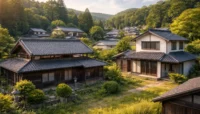
Akiya (空き家) literally means "empty house" in Japanese. The word is made of two parts: 空き (aki, empty or vacant) and 家 (ya or ie, house). It refers to any residential property that is currently unoccupied — from a near-new suburban house whose owner moved away, to a century-old farmhouse slowly returning to nature.
Not all akiya are the same
The word akiya covers a huge range of properties. The internet tends to show the extremes — either a collapsing ruin listed for ¥0, or a beautifully renovated kominka turned into a guesthouse. The reality is more nuanced. Japan's 2023 Housing and Land Survey counted 9 million vacant dwellings, and they fall into several categories.
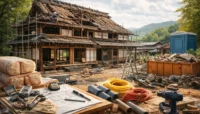
Some are held for future sale or rental — technically empty but on the market. Others serve as secondary residences used occasionally. The ones that make headlines are the 3.85 million long-term vacant properties with no clear market purpose: nobody is selling them, renting them, or using them. These are the akiya that municipalities are trying to deal with.
Akiya vs kominka vs machiya
These three terms overlap but mean different things. Understanding the distinction helps when browsing listings or talking to agents.
| Term | Meaning | Typical location | Age |
|---|---|---|---|
| Akiya (空き家) | Any vacant house | Anywhere in Japan | Any age |
| Kominka (古民家) | Traditional folk house, often a farmhouse | Rural areas | Usually pre-1950, often 100+ years |
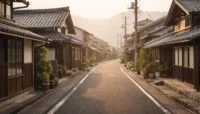
| Machiya (町家) | Traditional narrow townhouse | Historic city districts (Kyoto, Kanazawa, Takayama) | Edo period to early 1900s |
| Kodate (一戸建て) | Any detached house (standard term) | Urban, suburban, or rural | Any age |
A kominka can be an akiya if it's unoccupied. A machiya can be an akiya if nobody lives there. The terms describe different things: akiya describes occupancy status, while kominka, machiya, and kodate describe the type of building.
空き家: 空 means sky or empty, き is a connecting particle, 家 means house. The reading is "a-ki-ya." You'll see it written in kanji (空き家), hiragana (あきや), or sometimes katakana on real estate listings. The government uses the kanji form in all official documents, including the Akiya Special Measures Law.
Why are there so many akiya?
Japan's akiya problem comes down to a collision of forces: a population that peaked in 2008 and has been shrinking since, young people leaving rural areas for cities, a cultural preference for new-build houses over used ones, a tax system that makes demolition financially painful, and a construction industry that keeps building 800,000+ new homes per year despite declining demand.
The result is a country with more houses than it needs — and the gap is widening every year. For the full breakdown, see Why Does Japan Have 9 Million Empty Houses?
Find which region of Japan fits your lifestyle and budget with the Prefecture Finder — compare all 47 prefectures on climate, cost, transport, and more.
Try the tool →Can foreigners buy akiya?
Yes. Japan places no restrictions on foreign property ownership. Any foreigner can buy an akiya regardless of nationality, visa status, or residency. You don't need to live in Japan, speak Japanese, or hold any particular visa. The legal framework is the same for foreign and Japanese buyers.
That said, owning an akiya does not give you the right to live in Japan — you still need a separate visa for that. And the buying process involves Japanese-language contracts, a judicial scrivener for registration, and tax obligations that apply even if you live abroad. For a complete walkthrough, see Can Foreigners Buy Property in Japan? or get the Complete Guide.
Where to find akiya
The main channels are akiya banks (空き家バンク) — municipal databases run by local governments — and standard Japanese real estate platforms like SUUMO, at home, and LIFULL HOME'S. Akiya banks are mostly in Japanese, fragmented across hundreds of municipal websites, and often hard to navigate.
The Akiya Labs directory aggregates 730+ akiya banks across all 47 prefectures into one searchable index — the largest English-accessible collection available.
Frequently asked questions
What does akiya mean in Japanese?
Akiya (空き家) literally means "empty house." It refers to any residential property that is currently unoccupied, regardless of condition or age.
What is the difference between akiya, kominka, and machiya?
Akiya describes occupancy status (vacant). Kominka are traditional rural farmhouses, usually pre-1950. Machiya are narrow urban townhouses in historic city districts. A kominka or machiya can also be an akiya if unoccupied.
Are all akiya in bad condition?
No. Akiya range from ruins to well-maintained homes that happen to be empty. Some are modern builds under 20 years old. Condition depends on the property, its age, and how long it has been vacant.
How many akiya are there in Japan?
The 2023 Housing and Land Survey counted 9 million vacant dwellings — 13.8% of all housing stock. The number is projected to reach 21 million by 2038.
Start your research
Budget modeling, hazard risk, neighbourhood services, akiya bank directory, and development signals across all 47 prefectures.