Why Does Japan Have 9 Million Empty Houses?
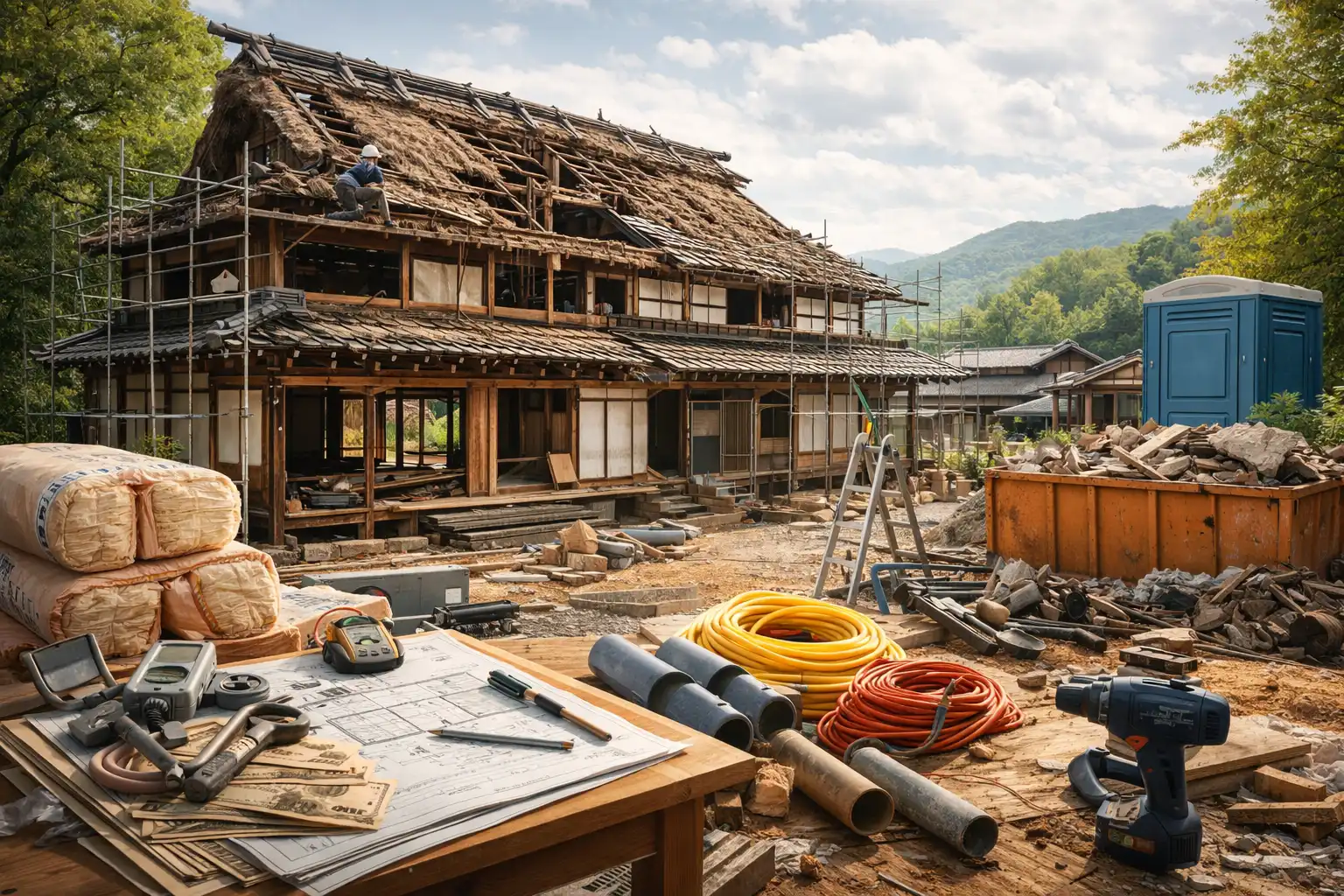
Drive through any rural town in Japan and you'll see them. Houses with curtains drawn for years. Gardens swallowed by bamboo. Mailboxes overflowing with yellowed flyers. Japan has over 9 million empty houses[1] — roughly one in every seven homes. In some rural towns, the number is closer to one in four. How did one of the world's most advanced economies end up with a ghost house crisis?
Japan is shrinking
The single biggest driver is one everyone knows but few grasp the scale of: Japan's population is in freefall.
Japan's population peaked at about 128 million in 2008. By 2024, it had dropped to roughly 124 million — 4 million fewer people in 16 years. The projections are stark: below 100 million by 2050, around 87 million by 2070[2]. That's a loss of 40 million people from the peak.
The birth rate tells the story. Japan's total fertility rate has been below replacement level (2.1) since 1974. In 2023, it hit 1.20 — the lowest ever recorded.[3] Fewer babies fifty years ago means fewer homebuyers today.
Fewer people need fewer houses. But the houses don't disappear when the people do. They just sit there.
Everyone moved to the cities
Japan's depopulation isn't evenly distributed. Tokyo, Osaka, Nagoya, and Fukuoka are still growing or stable. The countryside is hemorrhaging.
Young people leave rural towns for university and jobs in the cities, and they don't come back. Their parents age and eventually pass away. The family home sits empty. Nobody in the next generation wants to live in a town with one convenience store and a 40-minute drive to the nearest hospital.
The government has a term for this: "genkai shūraku" (限界集落) — literally, "marginal settlement." Communities on the edge of extinction. There are thousands of them across Japan.
Japan counted 9 million vacant dwellings in 2023 — 13.8% of all housing stock.[1] Even after removing vacancies held for rental, sale, or secondary residence use, 3.85 million remain as long-term empty houses with no clear market purpose. That's more than the entire housing stock of countries like Portugal or Sweden.
Check population trends and infrastructure signals for any area in Japan with the Future Development Map.
See the map →The Japanese don't buy used houses
Here's the part that surprises most foreigners: Japanese people strongly prefer brand-new houses.
In the US, UK, and most of Europe, buying a second-hand home is normal — even desirable. Period features, established neighbourhoods, character. In Japan, it's the opposite. A used house carries a stigma. The previous owner's energy lingers. The layout reflects someone else's life.
Roughly 85% of home purchases in Japan are new builds[1]. In the US, that figure is closer to 15%. It's a complete inversion. Without demand for older homes, prices collapse — and owners stop bothering to sell.
Houses depreciate like cars
The Japanese tax system treats residential buildings as depreciating assets. A standard wooden house (木造, mokuzō) has an assessed useful life of 22 years[5]. After that, its value approaches zero.
This isn't just a tax technicality — the market follows the same logic. Real estate agents, banks, and buyers all treat older houses as worth little or nothing. The land retains value; the building doesn't.
A Victorian terrace in London from 1880 might be worth £1 million. In Japan, a 1980 house is considered past its prime. A 1960 house is a teardown. The building has negative value because you'd have to pay to demolish it.
This creates a vicious cycle: houses lose value, so owners don't invest in maintenance, which accelerates deterioration, which confirms the belief that old houses are worthless. For a deeper look at how this affects buyers, see Why a Cheap Akiya Is Not Always a Good Deal.
The tax trap that keeps empty houses standing
You might think: if the house is worthless, just tear it down and sell the land. Logical, right?
Wrong. Japanese tax law gives residential land a massive tax break. If a house — any house, even a collapsing wreck — stands on the land, property tax is reduced by up to 83%[5]. Tear down the house, and your annual tax bill jumps up to six times higher.
So owners face a grim calculation: pay ¥30,000 a year in taxes with the ruin standing, or pay ¥180,000 a year with it torn down — plus ¥1–3 million for the demolition itself. Most choose to do nothing.
The government recognized this and tightened the rules in 2015 and again in 2023.[5] Houses designated as "tokutei akiya" (特定空家, specified vacant houses) or "management-deficient akiya" can lose their tax break. But enforcement is slow, and many municipalities lack the staff to inspect every empty house.
Inheritance is complicated
In Japan, property passes to heirs automatically upon death. But registering that inheritance — updating the official ownership records — was not mandatory until April 2024[4].
The result: decades of unregistered inheritance. A house might technically belong to the grandchildren of the original owner, but none of them know it, want it, or have ever visited the town where it sits.
The Ministry of Justice estimated that in 2017, the total area of land with unknown or unregistered ownership was roughly the size of Kyushu[4] — Japan's third-largest island. The 2024 law now requires inheritance registration within three years, but it will take years to clear the backlog.
Japan keeps building new houses anyway
Despite a shrinking population and millions of empty homes, Japan continues to build roughly 800,000 to 900,000 new houses every year[1].
The construction industry is a significant part of the Japanese economy. Tax incentives, easy mortgages, and favourable building regulations keep the industry running. Combined with the cultural preference for new homes, this creates an absurd dynamic: Japan simultaneously has too many houses and keeps building more. Old houses empty out as occupants move into newly built ones next door.
What's being done about it?
The Akiya Special Measures Law (2015, updated 2023)
This law gave municipalities power to identify, inspect, and act against dangerous or neglected vacant houses. In extreme cases, they can order demolition at the owner's expense. The 2023 update added the "management-deficient" category as an intermediate step.
Akiya banks
Local governments across Japan have set up akiya banks (空き家バンク) — databases where owners list vacant properties and buyers can browse them. There are now over 700 across the country. The Akiya Labs directory maps 730+ akiya banks across all 47 prefectures, searchable in one place.
Migration incentive programs
Many rural municipalities offer cash grants, renovation subsidies, free childcare, and other incentives to attract new residents. Some give away houses for free. These programs mostly target Japanese urban-to-rural migrants, but some are open to foreigners.
Mandatory inheritance registration (2024)
The new law requiring inheritance to be registered within three years should gradually reduce the number of properties with no clear owner.
Realistically, no. The Nomura Research Institute projects that by 2038, roughly one in three Japanese homes could be vacant — approximately 21 million empty houses.[6] Demographic trends are locked in. The government's efforts are slowing the problem, not reversing it.
Why this matters to you
Japan's empty houses represent some of the most affordable real estate in the developed world. A habitable house in a beautiful rural setting for $20,000–$50,000. A renovation project in a mountain village for $5,000. A traditional kominka with a century of character for the price of a used car.
Foreigners can buy with no restrictions. No nationality requirement, no visa requirement, no residency requirement. The government actively wants these houses occupied.
It's not for everyone. Rural Japan requires a car, a tolerance for isolation, and a willingness to navigate a foreign language. The houses often need real work. And Japanese property doesn't appreciate the way Western property does.
But for the right person — someone looking for a creative project, a vacation home, a base for exploring a fascinating country, or simply a slower, cheaper life — Japan's 9 million empty houses are waiting. The Complete Guide to Buying Property in Japan walks you through every step of making it happen.
Frequently asked questions
How many empty houses are there in Japan?
Japan's 2023 Housing and Land Survey counted 9 million vacant dwellings — 13.8% of all housing stock. Of these, 3.85 million are long-term empty with no clear market purpose.
Why are there so many abandoned houses in Japan?
The main causes are rapid population decline, urban migration from rural areas, cultural preference for new-build homes, a tax system that penalizes demolition, complicated inheritance rules, and continued overbuilding.
Can foreigners buy abandoned houses in Japan?
Yes. Japan places no restrictions on foreign property ownership. Any foreigner can buy regardless of nationality, visa status, or residency.
What is an akiya bank?
Akiya banks are municipal databases where owners list vacant properties for sale or rent. There are over 700 across Japan's 47 prefectures.
Will the empty house problem get worse?
Yes. Projections suggest roughly one in three homes could be vacant by 2038 — approximately 21 million empty houses.
Are empty houses in Japan really free?
Some are listed at ¥0, but "free" houses always come with costs: registration fees, taxes, renovation (often ¥3–15 million), and ongoing maintenance. The purchase price is rarely the biggest expense.
Start your research
Budget modeling, hazard risk, neighbourhood services, akiya bank directory, and development signals across all 47 prefectures.
Sources
- Statistics Bureau of Japan, Housing and Land Survey 2023
- National Institute of Population and Social Security Research, Population Projections for Japan
- Ministry of Health, Labour and Welfare — Vital Statistics 2023 (fertility rate data)
- Ministry of Justice — Mandatory Inheritance Registration Law, effective April 2024
- MLIT, Akiya Special Measures Law (2015, updated 2023)
- Nomura Research Institute — vacant housing projections to 2038